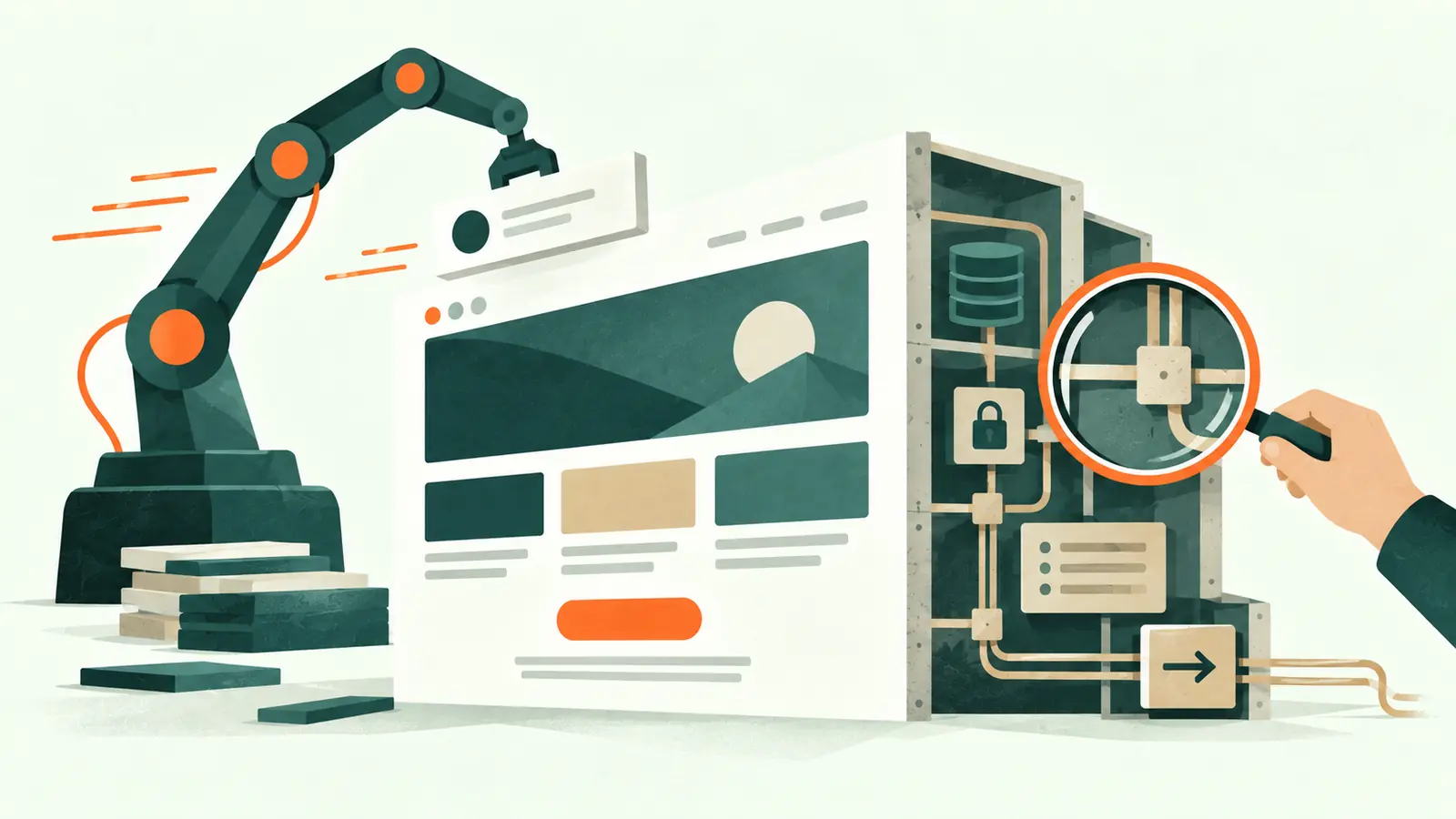
AI website builders have moved beyond producing a slightly odd landing page from a sentence. Platforms such as Lovable can now generate a working front end, connect a database and authentication, add integrations and publish the result. For the right job, that is genuinely useful.
It is also easy to confuse speed of production with completeness.
A prompt can create something visible in minutes. It cannot remove the need to decide what the site is for, whose data it will hold, how people will use it, who will maintain it and what happens when the first unusual case appears.
The balanced question is not “Are AI builders good or bad?” It is “What are they good at, and which responsibilities remain with us?”
What Lovable actually is in 2026
Lovable describes itself as an AI-powered platform for building full-stack websites through natural language. In practice, it is closer to an AI-assisted web-development environment than a traditional visual website builder.
You describe what you want, refine the result through conversation and can inspect or edit the generated project on paid plans. Lovable can host the published app with HTTPS, provide a lovable.app address and connect a custom domain on paid plans. Newer projects use server-side rendering—generating readable page content on the server before it reaches the browser—which is an important improvement for visitors and search-engine access.
It can also sync code in both directions with GitHub. That gives teams a copy outside the platform, normal version control and the option to work locally or deploy elsewhere. Lovable's documentation says users own their code and data and may host some or all of an app outside Lovable.
Those details matter because some older criticism of no-code tools assumes that the work is trapped inside a proprietary editor. Lovable has made portability a genuine strength.
Advantage: it shortens the distance from idea to test
The clearest benefit is speed. A consultant who wants to test a calculator, a small internal dashboard or a new client portal can create a functioning first version without commissioning every screen and interaction from scratch.
That changes the economics of experimentation. Instead of debating an abstract specification for weeks, people can react to something tangible. A rough but working model often reveals that the original idea was missing a step, asking the wrong question or solving a problem nobody actually has.
For prototypes, proof-of-concept tools and tightly scoped internal applications, that can be excellent value.
Advantage: ordinary language becomes part of the interface
Non-developers can participate more directly. A business owner can ask for a change in the language of the business rather than translating every request into a technical ticket.
This does not make expertise irrelevant. It does make collaboration faster. A designer or developer can use the first generated version to clarify requirements, then improve the structure, accessibility and code where necessary.
The best results tend to come from incremental instructions: establish the audience and task, build one flow, test it, then extend. A single enormous prompt asking for an entire polished business is still likely to produce confident assumptions.
Advantage: code access reduces lock-in
Git sync—keeping the project connected to a separately versioned copy in GitHub—and downloadable code are significant safeguards. They make it possible to review changes, use branches, involve another developer and retain a copy of the project.
There are qualifications. Direct code download is a paid-plan feature, although Git sync is available across the listed plans. Owning generated source code also does not guarantee that moving it will be effortless. An application may depend on Lovable Cloud, connected services, environment variables or deployment configuration that must be replaced elsewhere.
Portability is therefore better thought of as an exit route that should be tested, not a comforting checkbox.
Limitation: a prompt is not a design brief
AI is very good at filling ambiguity with plausible choices. That is useful when exploring, but risky when the choices carry business meaning.
If the instruction is “make a modern website for an accountant”, the result may look competent while saying very little about that accountant's clients, specialisms, location, process or reasons to trust them. It may reproduce familiar design patterns because familiar patterns are statistically easy to generate.
Professional design involves deciding what deserves emphasis and why. It includes content hierarchy, real objections, accessible interaction, error states and the quieter moments between the hero section and the final button. Those decisions still require knowledge of the business and observation of users.
Limitation: accessibility needs more than a plausible interface
Generated interfaces can look orderly while remaining difficult to use with a keyboard, screen reader, zoomed text or reduced motion. A form may have neat labels visually but no dependable programmatic relationship between each label and field. A fashionable low-contrast palette may pass casual inspection while failing people using a phone outdoors or living with impaired vision.
AI can help identify and repair some of these issues, but the instruction must first recognise them as requirements. “Make it accessible” is also too broad to replace testing. The important questions concern real tasks: can somebody reach every control without a mouse, understand an error, pause movement, enlarge the page and complete the main journey without losing information?
This matters commercially as well as ethically. An inaccessible enquiry form excludes potential clients. An ambiguous button or keyboard trap is still a failed interaction even when the rest of the application was generated remarkably quickly.
For anything beyond a disposable prototype, accessibility belongs in the brief, the component choices and the acceptance checks. It should not be postponed as a polishing exercise after every interaction has already been built.
Limitation: generated software still needs testing
Lovable runs a basic security scan during publishing and offers deeper scanning for application-code vulnerabilities. These are welcome controls. Its documentation also says security findings may not block publication by default unless stricter workspace policies are configured.
No automated scan proves that an application is secure. A generated form may validate ordinary input and still expose data through a misconfigured permission rule. An authentication flow may work for its creator and fail during password recovery. An integration can behave perfectly until a third-party API returns an unexpected response.
The higher the consequence of failure, the more human review matters. A public brochure site and a portal containing health, financial or client-confidential information should not have the same test plan.
Somebody still owns the operational decisions
An AI builder can implement authentication, storage and integrations, but it cannot accept responsibility for who should see which records, how long data should be retained or what happens when an employee leaves. Those are business decisions expressed through technical settings.
Before launch, identify the owner of each important system: domain, deployment, database, connected services, payment account, analytics and backups. Record who has administrator access and how another competent person could take over. A working application tied to one person's email address is a fragile business asset.
The same applies to change control. Fast conversational editing makes small alterations feel harmless, yet a request to “simplify permissions” or “fix the database” may affect every user. Version history and GitHub copies help, but recovery is useful only when somebody knows which version was sound and how to restore it.
This is less exciting than watching a new feature appear from a prompt. It is also the difference between an impressive demonstration and a system a business can responsibly depend on.
Limitation: privacy settings require an active decision
Lovable's documentation was updated on 9 September 2026 to explain how customer data may be used for AI training. On Free and Pro plans, prompts, attached files, project code, generated outputs and usage data may be used to train and improve models unless the account opts out. Business and Enterprise workspace data is excluded by default. Lovable says app end-user data and account and billing information are not used for training.
That does not make the platform unusable. It does mean a business should check the current setting before pasting confidential material, client documents or commercially sensitive code into a project. Data-processing agreements, subprocessors, hosting regions and access controls deserve review when personal data is involved.
The policy may change again, which is why an AI platform should be reviewed as an active supplier rather than treated like a piece of software bought once.
Limitation: content-led sites need an editorial system
Lovable's current SEO documentation says apps created from 13 May 2026 use server-side rendering, and it describes per-page metadata and SEO review features.
That solves an important technical problem; it does not create a content strategy. A service business that depends on regular articles, case studies, team updates and local landing pages needs a dependable way to create, review, organise and maintain that content.
A conventional content-management system such as WordPress may remain the more comfortable choice for that job, particularly where several non-technical people edit content. An app-like service with custom interactions may favour Lovable. The platform should follow the operational need, not the current excitement.
The cost moves rather than disappearing
AI builders reduce some production time, particularly at the beginning. They do not remove hosting, subscriptions, testing, content work, integrations, maintenance or the cost of recovering from a poor decision.
A fair comparison should include the whole operating period. Consider the platform plan, usage-based services, database and storage growth, paid APIs, custom-domain requirements and the time spent prompting, checking and correcting. Then consider what happens if the person who created the project is unavailable.
For a simple experiment, accepting some uncertainty can be rational because the cost of failure is low. For a core business process, paying for architecture, testing and documentation may remain sensible even when the first version was inexpensive to generate. The relevant saving is not “hours of code avoided”; it is the total cost of reaching and maintaining an acceptable result.
Where an AI builder makes good sense
Lovable is particularly interesting for:
- Prototypes that need to become testable quickly.
- Internal tools and dashboards with a known group of users.
- Calculators, directories and interactive lead-generation ideas.
- Early-stage products whose assumptions still need validation.
- Designers and developers who want a generated starting point but retain code control.
It can also produce a simple public website. The question is whether its app-oriented strengths solve a real need or add a new system for a business that only required clear pages and an easy publishing workflow.
Where I would be more cautious
Extra care is sensible when the project holds sensitive personal data, controls payments or permissions, depends on complex business rules, requires extensive accessible interaction or must be maintained for years by a non-technical team.
I would also be cautious when the main sales promise is that the owner will never need professional help again. AI can reduce production time, but somebody still owns the brief, the facts, the design decisions, the testing, the legal obligations and the maintenance.
The most useful model may be hybrid
The choice is not necessarily DIY AI or traditional agency. A business owner can use an AI builder to make an idea concrete, then ask a designer or developer to review the user journey, visual system, accessibility, security and long-term setup. A professional can use it to accelerate routine construction while spending more time on research and judgement.
That is where the technology becomes most convincing: not as an instant substitute for every discipline, but as a faster way to explore and build under informed supervision.
If you are deciding between an AI builder, WordPress, Shopify or another platform, begin with the business and maintenance requirements rather than the demo. My web design services are platform-aware but problem-led. You can contact me for a candid discussion, including when a simpler option is likely to be enough.
Sources and further reading
- Lovable FAQ
- Lovable subscription plans
- Sync a Lovable project with GitHub
- How Lovable hosts an app
- Publish a Lovable project
- Security overview — Lovable
- Manage training data and privacy — Lovable
- SEO and AI search — Lovable
- Web Content Accessibility Guidelines — W3C
Important note
This article provides general information and professional commentary. It is not advice tailored to your particular business, website or circumstances, and it should not be treated as legal, financial, privacy, accessibility, cybersecurity or other specialist advice. Any opinions are my own professional judgement based on the information available when the article was researched.
Products, prices, services, software and official guidance can change. External links are provided for reference; I do not control third-party websites and cannot guarantee their continuing availability, accuracy or content. A link does not imply endorsement of everything published by that source.
Check current official information before making an important decision. Test technical changes safely, keep a verified backup, and obtain appropriately qualified advice where the consequences warrant it. Any sponsorship, free product, affiliate link or other commercial relationship relevant to the article will be clearly disclosed.